


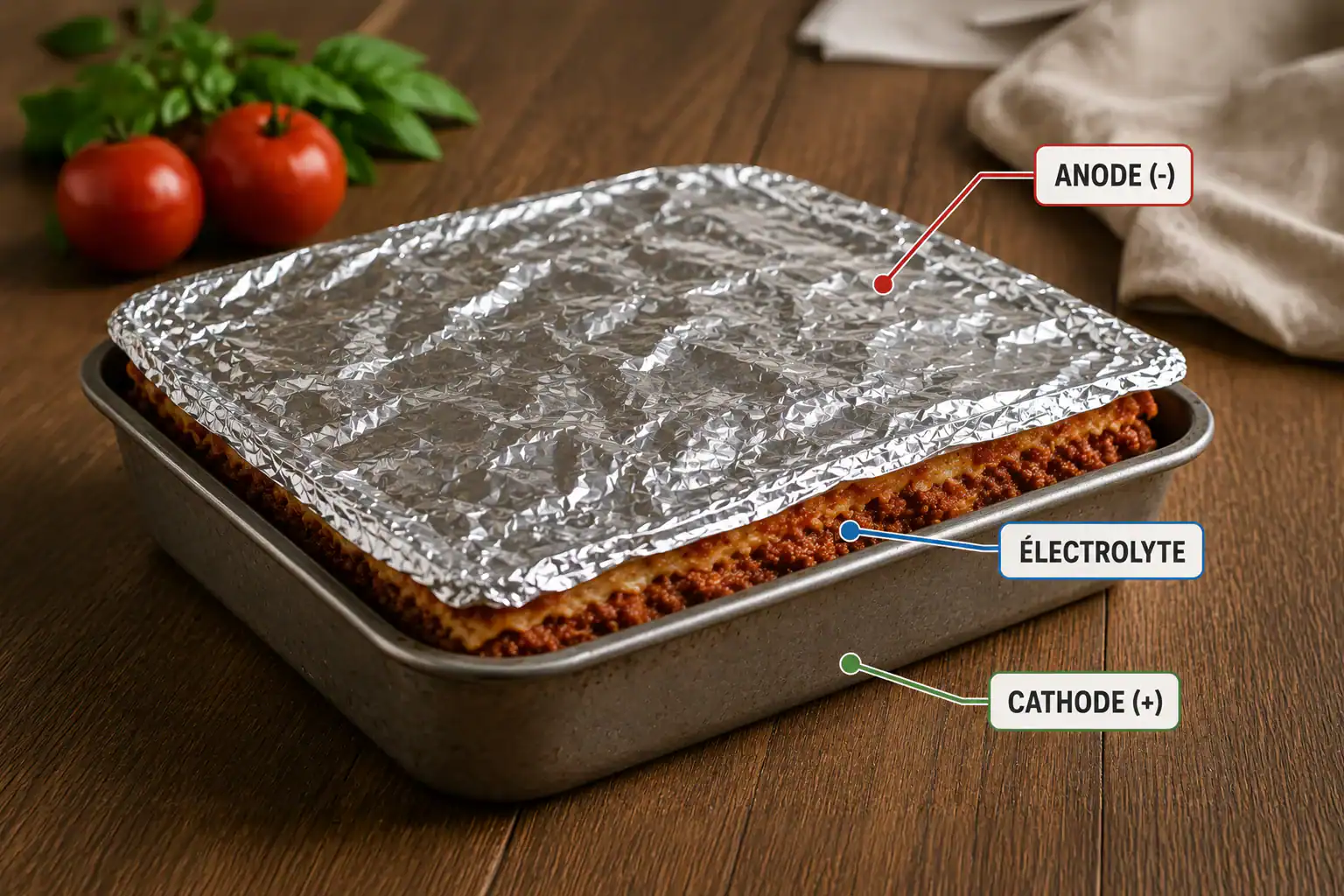
Have you ever removed the aluminum foil covering a lasagna dish only to discover that it was dotted with tiny holes?
This surprising phenomenon is commonly known as the “Lasagna Battery.” As the name suggests, your lasagna can actually create the conditions necessary for the formation of a small electrochemical cell.
This phenomenon can occur when a moist, salty food is stored in a steel baking dish and covered with aluminum foil. In this setup, the steel dish acts as the cathode, the lasagna as the electrolyte, and the aluminum foil as the anode.
- Cathode: a material where the reduction reaction occurs, i.e., the consumption of electrons. In this case, it is the steel dish.
- Electrolyte: a conductive medium that allows the movement of electrical charges between the anode and the cathode. In this case, it is the lasagna, primarily due to its water content and dissolved salts.
- Anode: the material where the oxidation reaction occurs, i.e., the loss of electrons. In this case, it is the aluminum.
When metals are in electrical contact, an electrochemical reaction can occur.
Aluminum, being the most anodic and least noble metal in the galvanic couple, is preferentially corroded. Since the foil is very thin, localized corrosion can eventually penetrate it and create the characteristic small holes observed after a few hours. This phenomenon is known in materials science as galvanic corrosion.
Interestingly, this same principle is intentionally used in non-rechargeable batteries. In a battery, the reaction between different materials is controlled to generate electricity. When a similar reaction occurs unintentionally between two metals, it can instead accelerate the corrosion of one of them and lead to its degradation.
Another common example of this type of phenomenon is the sacrificial anode in a water heater. This rod, typically made of magnesium or aluminum, is composed of a metal less noble than the steel used for the tank. In the presence of water, the sacrificial anode oxidizes and corrodes before the steel in the tank, thereby protecting the tank from corrosion and reducing the risk of tank perforation.
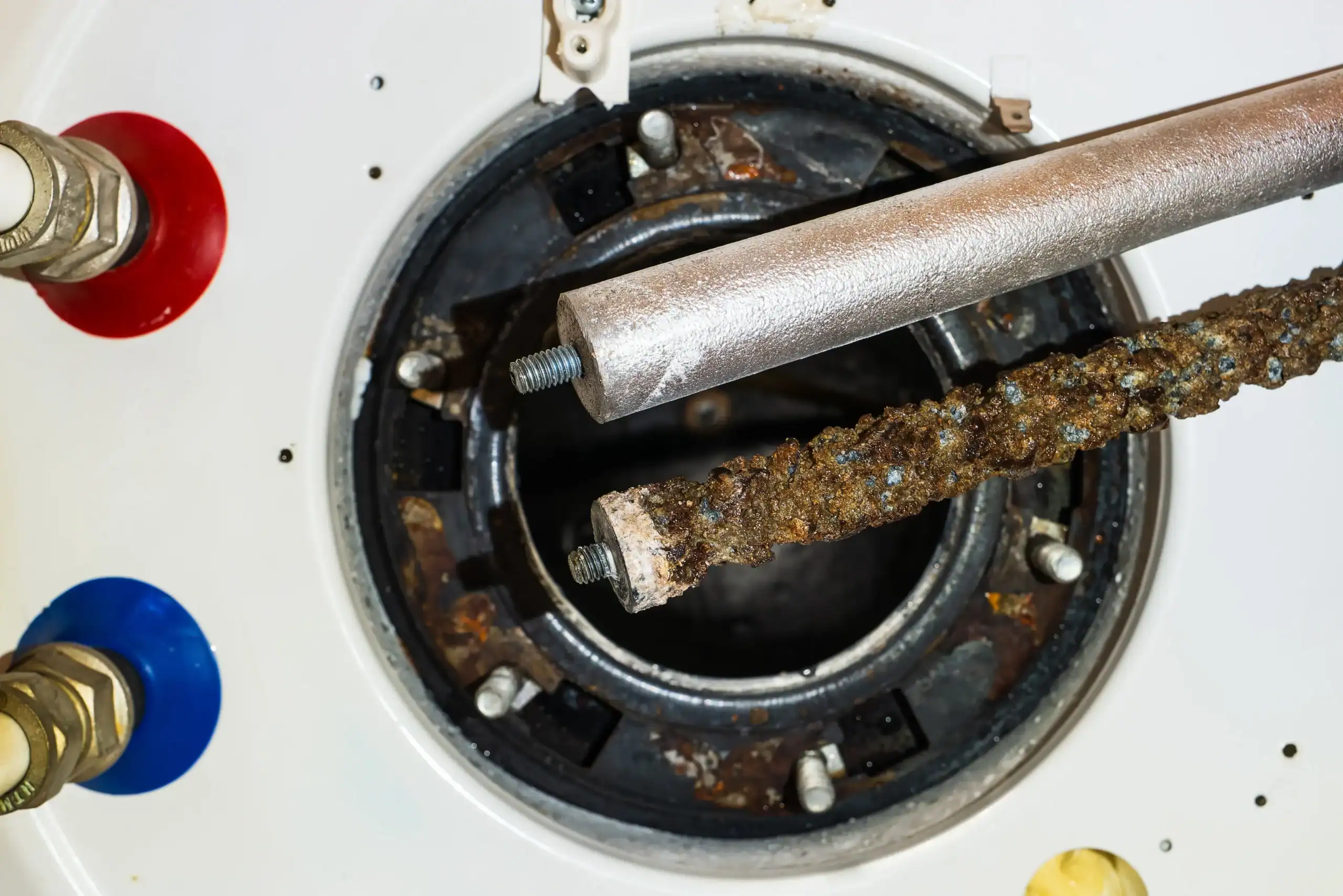 Sacrificial anode
From lasagna to plumbing: the same electrochemical phenomenon, but a water leak is generally less appetizing.
In conclusion
Galvanic corrosion is a particular failure mode to consider in plumbing. When a system brings different metals into electrical contact—for example, in certain copper-and-steel assemblies—water can provide the electrolytic medium necessary for the phenomenon.
The most anodic metal or metal alloy used in plumbing components can then undergo accelerated corrosion due to the phenomenon of galvanic corrosion. Over time, this degradation can lead to a loss of thickness, perforation, the failure of various plumbing components, and, eventually, a water leak.
Thus, the small holes observed on a sheet of aluminum and certain failures encountered in plumbing may have an unexpected commonality: behind both of these situations lies the same phenomenon of galvanic corrosion.